Skip to features
NEWIntroducing AVA 4.01.6k

Visual Analytics.
Open Source, Built for Agents.

An open-source framework for AI agents to explore, analyze, and visualize data.

From Raw Data to
Answers You Can Inspect.

Files and databases.
One interface.

A consistent data context lets your agent reason across different sources.

Explore data sources

An answer with
an evidence trail.

Executed queries and their results give each answer a checkable basis.

Explore trusted analysis

The right chart.
For your question.

The question and the shape of the data guide the chart choice.

Explore intelligent visualization

Data Security.
Run AVA Locally.

You control where analysis runs and which model endpoint it uses.

Explore local engines

Accuracy you
can inspect.

Accuracy is measured against reference answers under published test conditions.

Explore published evaluations

Ready for your agent.
Built to reuse.

Your agent provides the reasoning; AVA executes the data workflow.

Get started with AVA

Connect Your Data.
Run Anywhere.

FilesDatabasesSaaS
All data sources

Trust the Analysis,
Not Just the Answer.

Measured on public benchmarks. Built for answers you can verify.

Context · DataBench · 1,789 questions
93.01%
answer accuracy with Semantic
model: GLM-5.1 · DuckDB · Direct
Raw data83.51%
Schema + Profile84.18%(+0.67 pp)
Semantic★93.01%(+9.50 pp)
  • Grounded in your data.

    Your schema and data context give the analysis a factual starting point.

  • Based on real computation.

    Answers are built from executed queries and returned results.

  • Open to inspection.

    Follow the queries and results behind the answer, and check them yourself.

Bring Analytics
to Your Agent.

Choose an Agent Skill, CLI, or TypeScript SDK.

Add the AVA Skill.

Uses your agent’s own model.

bash
# install the skills for your agents
$ npx skills add antvis/AVA

# or add the marketplace in Claude Code
$ /plugin marketplace add antvis/AVA

# then, in a new agent session:
"Use the AVA skill to analyze /absolute/path/sales.csv,
 compare sales by region, and generate a chart."

Built on AVA.
Shared by the Community.

Projects, extensions, and ideas from the AVA community.
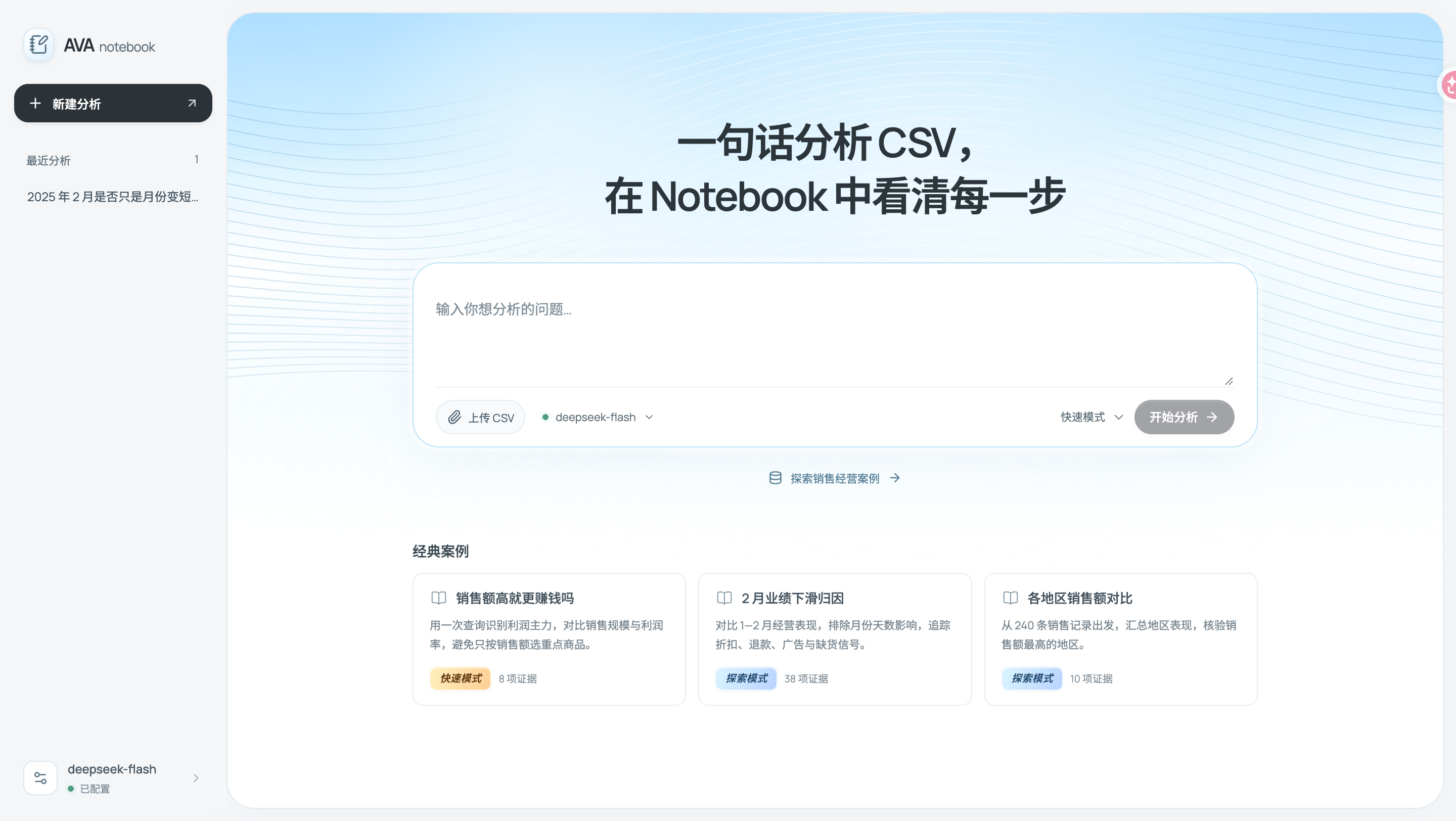
AVA Notebook project screenshot

AVA Notebook

Community
yvonneyx/ava-notebook

Revisit the SQL, results, and evidence behind your analysis in an editable notebook.
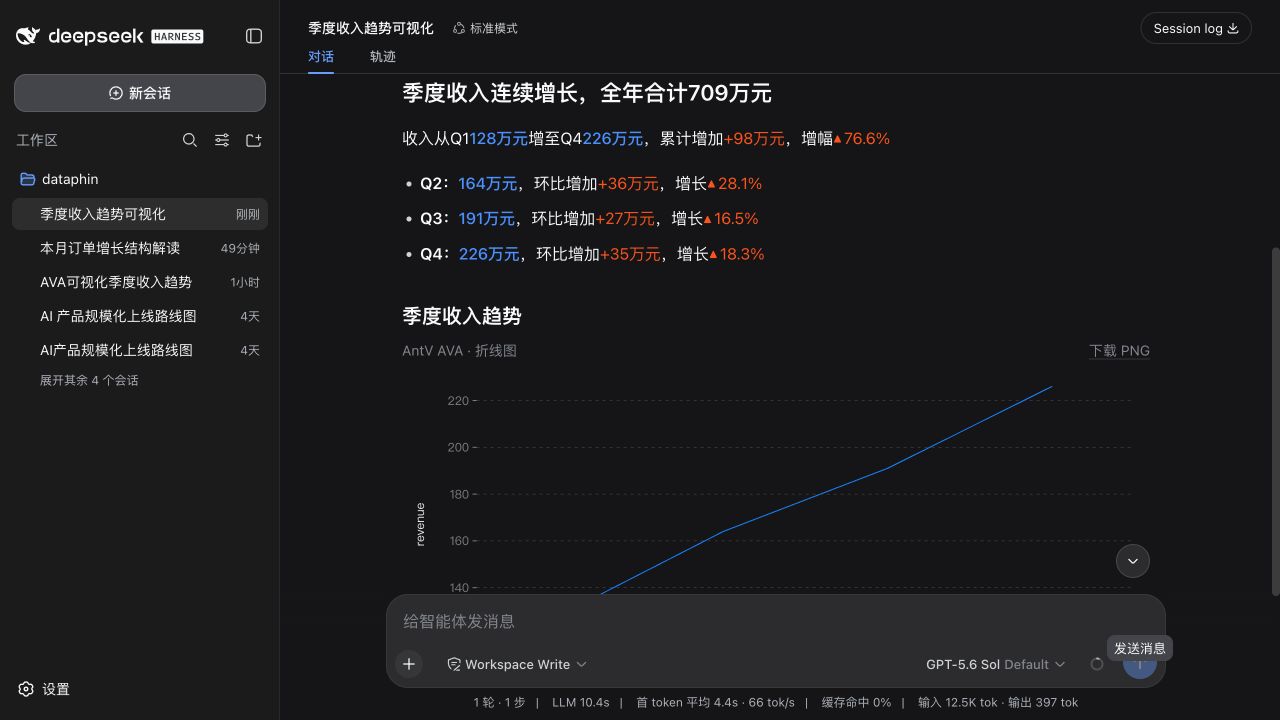
ava-observability

Community
lyw405/ava-observability

Trace analysis steps, timings, and SQL attempts through AVA’s public events.
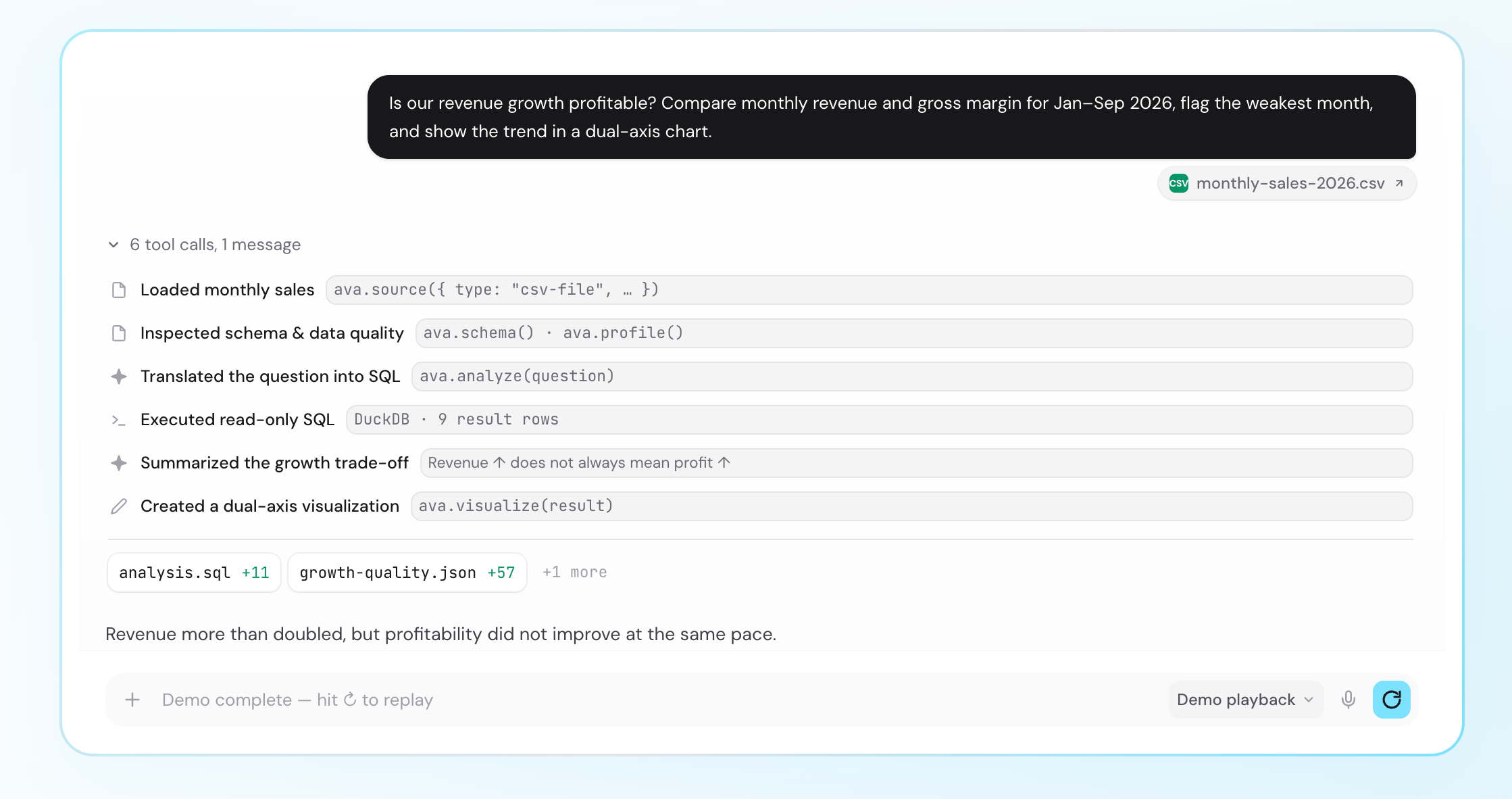
AVA Agent Skill project screenshot

AVA Agent Skill

Official
antvis/AVA

Explore data and generate charts directly from the AI agent you already use.
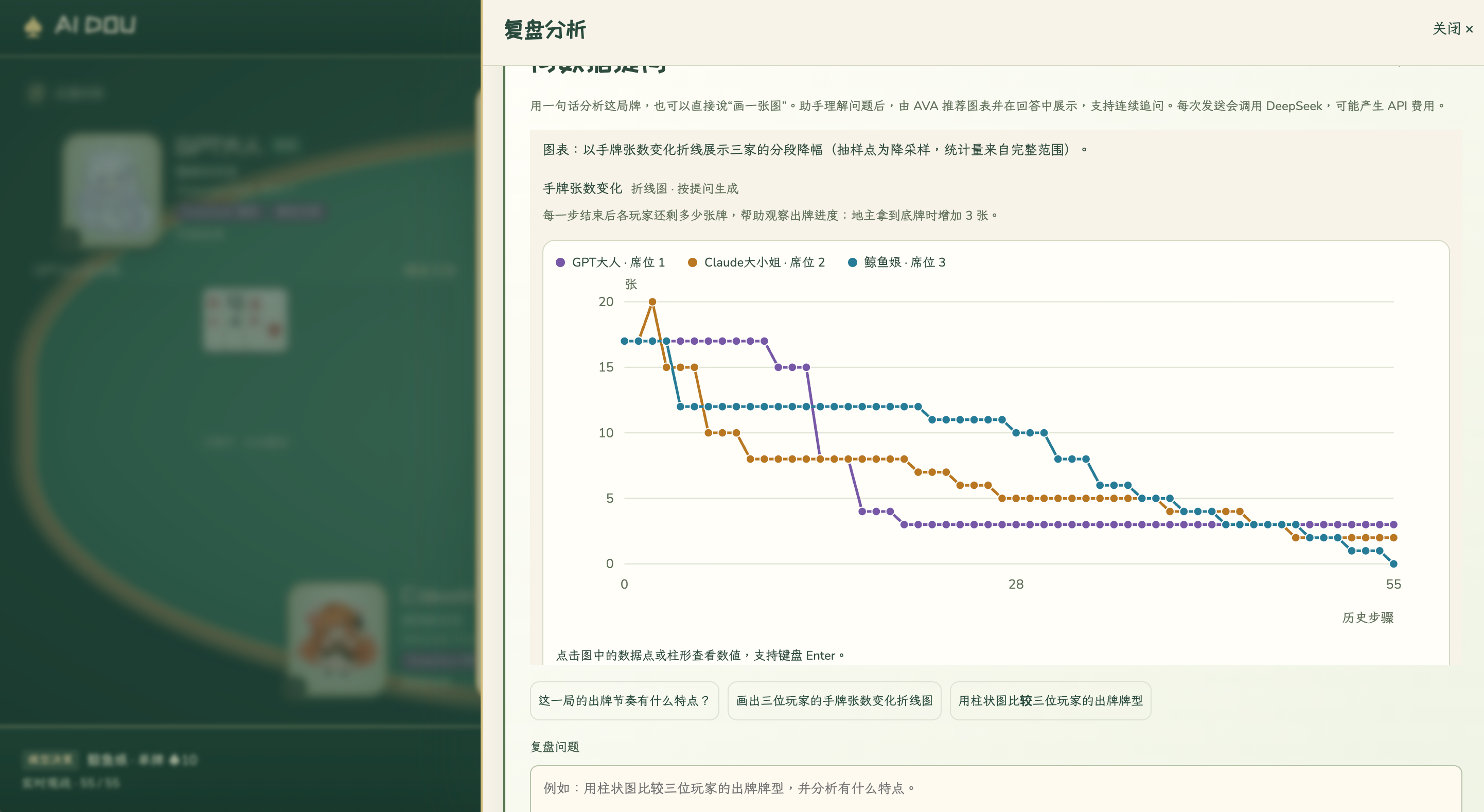
AI Dou project screenshot

AI Dou

Community
Keikeikm/ai-dou

Review AI card games through match data, analysis, and visual recaps.

AVA Feishu Bot

Community
antvis/AVA #1035

A proposed chat bot for querying files and returning answers and charts in Feishu.

AVA Feishu Plugin

Community
antvis/AVA #1035

A proposed Bitable plugin for analyzing and visualizing data inside Feishu.

How AVA Works.
What You Need to Start.

What is AVA?
AVA is an open-source visual analytics framework from AntV. It gives AI agents the tools to connect to data, understand its structure, run analysis, and turn results into charts.
How can I get started?
Try the AI playground, add the Agent Skill to your agent, or follow the TypeScript SDK quickstart. You can also use AVA from the command line.
Which data sources can I use?
AVA supports CSV, JSON, Excel, Parquet, and text, plus SQLite, MySQL, PostgreSQL, MongoDB, Supabase, ClickHouse, and Feishu Bitable. Available sources and engines depend on your runtime.
Do I need a separate model API key?
The Agent Skill uses your agent’s own reasoning, so it does not need a separate model key. AI-powered analysis through the SDK or CLI requires your model configuration. Direct queries and data profiling can run without an LLM.
Is AVA free and open source?
Yes. AVA is released under the MIT License. You can inspect the source, build with it, and contribute on GitHub. Model providers and hosted infrastructure may have their own costs.

Your agent’s next skill?
Understanding your data.

Connect, analyze, and visualize — with the tools your agent needs.